
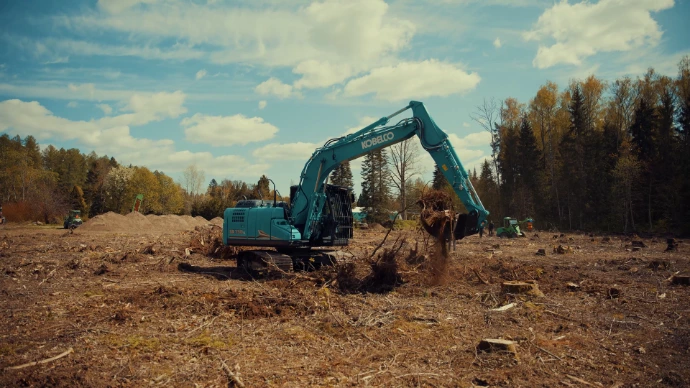
Why don't you just dig the stump out if you already have an excavator?
We often hear this question from people when they first meet with the Dipperfox vertical Stump Grinder.
To use the Dipperfox 850PRO, carrier excavators need to be large enough to dig out stumps of almost any size.
So why do you need Dipperfox to remove stumps?
Well, there are several reasons to invest in a Dipperfox.
Much smaller ecological footprint on nature
To dig it out, the operator needs to crush the roots from both sides of the stump.
Once done, the stump can be removed.
So at least 4-5 buckets of material will be removed together with the stump. And the area affected by the digging is at least 15 times as big as the stump’s diameter.
With the Dipperfox Vertical Stump Grinder, you only impact the area where the stump is actually located. Even if you go underground to smash the roots, the footprint on the surface will be significantly smaller than the digging itself.
With disturbed ground that is full of holes, the next job becomes harder. This applies to most land clearing work, such as peatland restoration.
Less damage means better access for equipment
Besides the ecological aspect, there are other pragmatic reasons to minimize the open areas in construction sites.
The most important factor is accessibility with construction machines. If the stumps are dug out, the craters will need to be filled to ensure access for machines that use wheels rather than tracks. And when the crates are filled, the protective layer of turf roots is damaged.
In wet conditions, it usually means a lot of mud and machines getting stuck.
With the Dipperfox Vertical Stump Grinder, only the wooden part of the stump will be ground. The rest of the landscape will maintain its initial carrying capacity.
Efficiency and cost
The efficiency of the Dipperfox Stump Grinders stands on two main objectives:
- working speed and,
- debris removal.
Let’s start with the speed. Even the most experienced operators need extra time to make 5 moves with the excavator bucket than just aim and drill.
And even for larger stumps, where drilling multiple craters is required, it will still be much faster than digging it out.
The second, and even more significant, game-changer is the process that takes place after the stump has been removed.
With Dipperfox, the material left behind is wooden chips, turning to fertilizer in the soil over the winter months.
But the stumps, which have been dug out, need to be collected, piled, dried, separated from the soil and wooden material, and transported into the chipper.
And the remaining holes left behind need to be filled with soil.
Fewer side effects
Digging out the stumps is usually quite intensive work for the equipment and requires high RPM from the excavator.
This impacts both fuel consumption and noise emission.
Dipperfox, on the other hand, doesn't require high engine rpm, and the work itself is much quieter, which benefits both the operator and the environment.
Running an excavator with a lower engine speed reduces its wear and tear. It saves boom joints, cylinder loops, and other moving parts, which will make the most of the stress of intense work.
Digging out the stumps
Pros:
- Smaller initial investment.
- The only option, if needed, to get all the roots from the ground.
Cons:
- Bigger ecological footprint.
- More time consuming compared to Dipperfox.
- Requires a lot of efforts after stumps are removed (waste treatment, filling the craters).
- Much more challenging for the equipment
- Higher fuel consumption compared to Dipperfox.
Grinding stumps with Dipperfox vertical Stump Grinder
Pros:
- Super effective with stumps (average stump takes about 20 seconds).
- Minimum risk of throwing material around (max speed is only 60 RPM).
- Can be used below the ground level (operators can use blades over rocks).
- No waste left behind (chipped material can be used as fertilizer for the ground).
Cons:
- Does not churn the smaller roots.
- Bigger initial investment.