
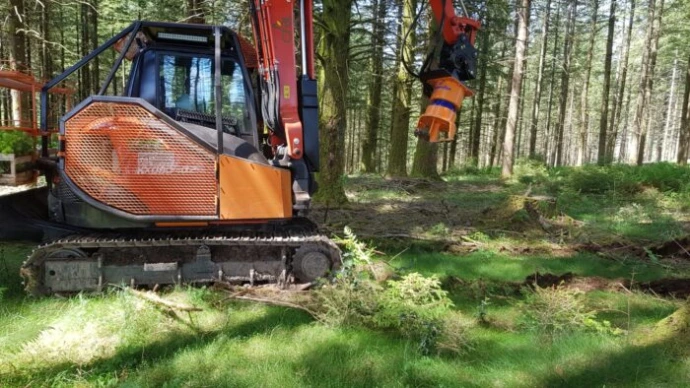
We asked French forestry expert Mr. Pascal Chouvenc to try out our Dipperfox SC600, and he accepted the challenge. He wrote down a review of the tool and what it's like working with it, where he explains:
- How to clean 14 hectares of stumps within 7 days with a 6t excavator?
- How to save 4 times on fuel while removing stumps?
- Why is stump removal with Dipperfox the most environmentally-friendly technology, leaving the smallest footprint on nature?
Feedback on the use of DIPPERFOX 600:
Current climate changes are forcing us to find the best environmentally friendly solutions. The idea, therefore, lies in allowing reforestation after clear-cutting, while limiting mechanical interventions that are costly in fossil energy, such as storing branches and whole-stump extraction, which are increasingly contested.
The best technique consists of keeping all the clear-cut remnants (branches, stumps, etc.) on the ground without any manipulation of the latter in order to install young plants directly following the intervention of mini excavators, which will move on the ground after clear-cutting in order to prepare the locations where the future plants will be positioned.
The first difficulty will then reside in the translation of the mini excavators, which will evolve amid stumps and branches, leading to numerous track breakages. It should be noted that after clear-cutting, it is still possible to avoid the stumps as the ground is still bare of all plants.
The second and real difficulty will then come the year after planting, during subsequent maintenance, with the objective of clearing the plants for the next five years. Mechanization of such interventions will be particularly difficult, if not impossible, as it is. Indeed, the mini excavator will be hindered in its translation by the remaining old stumps, making it impossible to go around because of the previously installed conifers.
Thanks to the DIPPERFOX stump crusher we can intervene before or even after planting the softwoods in a quieter period to eliminate the stumps on the areas of passage of the mini excavator.
Knowing that a mini excavator equipped with a crusher located at the end of its dipper will treat four rows of plants in each pass, the intervention with the DIPPERFOX will be limited to the treatment of the stumps only in the row that the excavator will take to move, i.e., one row every three rows (three spacings correspond to 4 rows of fir trees).
In this way, the DIPPERFOX will make it possible to definitely treat the stumps with an efficiency incomparable to traditional stump extraction for the following reasons:
1. Work carried out with an excavator of a tonnage of 6 tonnes.
2. Very low fuel consumption of around 70 liters per day compared to 250 liters per day for a 20-tonne excavator, notwithstanding the advantage linked to the ease of transport and implementation of a small excavator, which will not require a flat-bed trailer specific to large excavators.
3. Substantial savings in absolute consumption on the same plot of land because only 1/3 of the surface area corresponding to future excavator passes will be treated; that is, the mass of fuel consumed is reduced by a factor of four compared with traditional stump removal, which consists of extracting all the stumps from a plot of land. Here, only a third of the surface is treated on the one hand, and only the aerial part of the stump is reduced.
4. Exceptional speed of treatment of a stump, namely a Douglas-fir stump with a diameter of 120 cm, will be brought back to ground level in 4 minutes maximum with a 6-tonne excavator.
The recent experiments we have carried out allow us to announce that we can treat an area of 14 hectares in 7 days with a 6-tonne mini excavator, whereas it would have taken 20 days for a conventional stump extraction with a 20-tonne excavator. In addition, the ecological aspect is reinforced by the fact that the stump is planed to ground level, the roots remain in the ground, the planing shavings stay on site, and thus will serve as humus for the new plants installed.
5. In addition to the fact that CO2 emissions are divided by six or seven and multiplied by five (taking into account the preparation but also the clearances), future clearances can be assured with certainty by mechanisation with a particularly significant increase in productivity compared to manual interventions (one hectare per day with an excavator compared to 0.4 hectares by hand) but above all an incomparable quality of work for the following reasons:
- Possibility to intervene at the most appropriate time during the season, without the stress of excessive heat or bad weather for employees, which could endanger the technicians. Not to mention that clearance work is the most physically demanding and that it is becoming increasingly difficult to recruit technicians for it.
- The mechanization of clearances allows adaptation of the cutting height of competing vegetation to the growth of young plants. Thus, a higher level of vegetation will make it possible to effectively combat deer-related fraying whilst maintaining a forest atmosphere that is particularly favorable to the development of young coniferous plants.
- Identical yields regardless of competing vegetation density
- Significant productivity gain, allowing for the limitation of hiring for future clearance interventions.
DIPPERFOX is really an indispensable tool because of its efficiency and its ecological contribution in the fast but effective surface treatment of stumps.
Thank you to JASON GILLETT for introducing us to this material, which gives us complete satisfaction and which we recommend.
Written by Pascal CHOUVENC, PPL Forestry Group Manager